🔍 Introduction: Businesses Are Tired of Managing Too Many Tools
For the past decade, companies have managed operations using separate software for:
- CRM
- Inventory
- Payroll
- ERP
- Accounting
- HRMS
- Support
- Project management
- Marketing automation
This fragmented approach worked temporarily, but by 2026 it has become:
❌ inefficient
❌ expensive
❌ chaotic
❌ difficult to scale
❌ impossible to automate
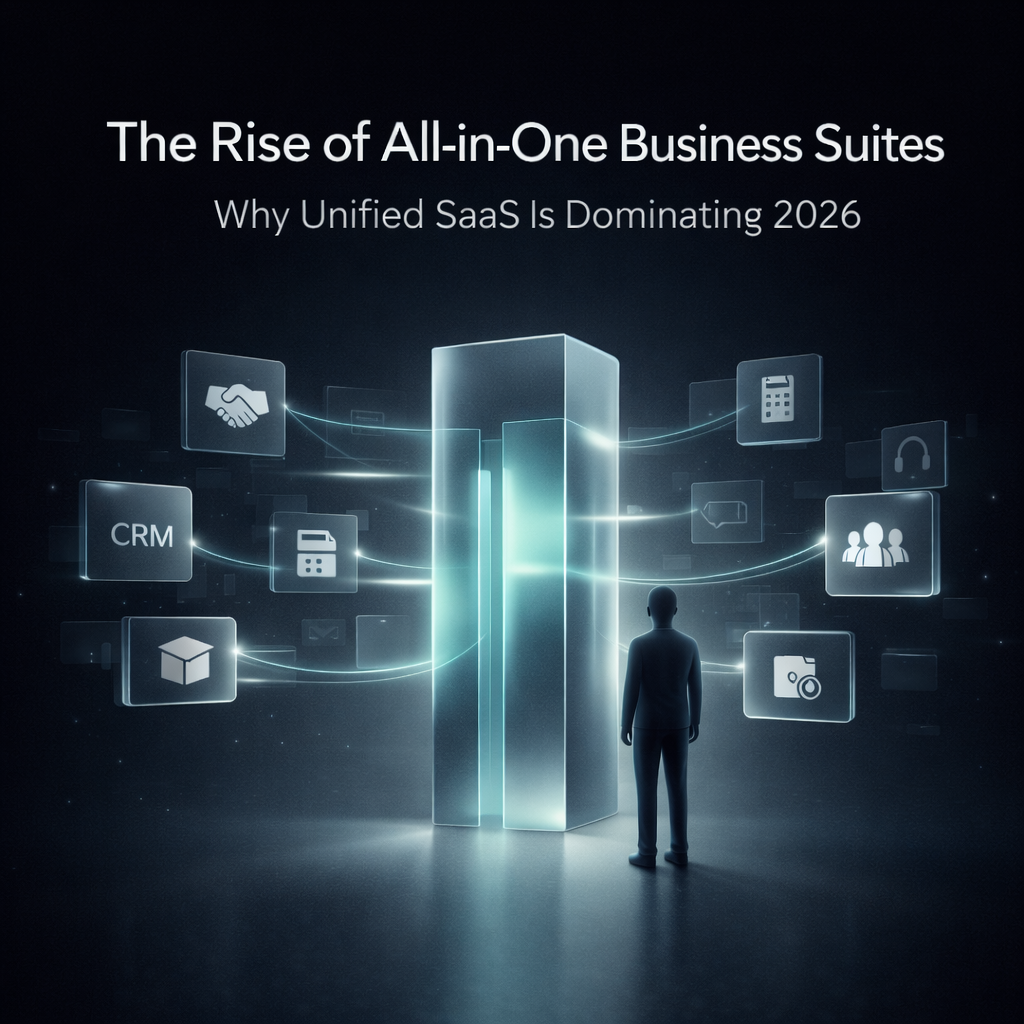
Businesses now realize the future is not “many tools working independently,” but one unified platform where everything works together seamlessly.
This shift is exactly why all-in-one business suites are dominating digital transformation roadmaps in 2026.
1. Fragmented Tools Slow Down Operations — Unified SaaS Speeds Everything Up
When each department uses separate systems, it creates:
❌ data silos
❌ miscommunication
❌ duplicate entries
❌ disjointed workflows
❌ delays in decision-making
A unified SaaS suite solves all of this.
It gives businesses:
✔ one database
✔ one login
✔ one workflow
✔ one dashboard
✔ one source of truth
Every team moves faster because the entire business runs on a single connected system.
This is why unified platforms are replacing standalone tools across India’s SME ecosystem.
2. Real-Time Visibility Is Only Possible With Unified Tools
A modern CEO needs instant answers like:
- What were today’s sales?
- What is our cash flow right now?
- Which customers need follow-ups?
- What is the current stock level?
- Which teams are overloaded?
- What approvals are pending?
With data spread across multiple tools, real-time visibility becomes impossible.
Unified suites offer:
✔ Real-time dashboards
✔ Live business performance reports
✔ Centralized analytics
✔ Instant department-wide insights
Speed of decision-making becomes a competitive advantage — something fragmented tools can never deliver.
3. Unified SaaS Platforms Reduce Software Costs Dramatically
Managing 8–10 different tools means paying for:
- Separate subscriptions
- Different user licenses
- Multiple upgrades
- Extra integrations
- Additional storage
- Separate support teams
This quickly becomes a financial burden.
A unified business suite consolidates everything into one affordable subscription, reducing cost and simplifying budgeting.
This is why SMEs are aggressively shifting to all-in-one platforms in 2026.
4. Teams Collaborate Better When All Data Lives in One System
When sales, support, finance, operations, and HR work on different tools, they rarely see the same information.
This causes:
❌ internal conflicts
❌ unclear ownership
❌ duplicated workflows
❌ poor hand-offs
A unified business suite creates:
✔ shared visibility
✔ shared context
✔ shared timelines
✔ shared outcomes
✔ seamless collaboration
Workflows become smoother. Teams become aligned. Productivity increases.
5. Automation Works 10× Better in a Unified Ecosystem
You cannot automate full business workflows when data lives in different tools.
For example:
Lead → Quote → Invoice
Attendance → Payroll → Accounting
Purchase → Inventory → Sales
Ticket → Escalation → Resolution
With fragmented tools, these workflows break.
A unified suite automates end-to-end processes:
✔ auto-assigning leads
✔ auto-triggering invoices after quotes
✔ auto-updating inventory after sales
✔ auto-notifying teams for delays
✔ auto-generating reports
Automation becomes powerful only when all modules speak the same language.
6. All-in-One Suites Reduce the Learning Curve for Teams
Instead of learning 7–10 systems, your team learns one interface.
Benefits include:
✔ faster onboarding
✔ lower training costs
✔ higher adoption rates
✔ fewer mistakes
✔ consistent usage across the company
In 2026, employee software experience is as important as customer experience — and unified suites deliver both.
7. Data Security Improves When Everything Is Centralized
Multiple tools multiply security risks:
❌ scattered databases
❌ outdated permissions
❌ inconsistent backups
❌ varying security standards
❌ risk of data leaks
A unified suite offers:
✔ centralized access control
✔ multi-layer encryption
✔ consistent cloud backups
✔ secure hosting
✔ role-based permissions
✔ audit logs
Data becomes safer, easier to govern, and easier to monitor.
8. Unified Systems Enable AI Adoption — Fragmented Systems Don’t
AI can only function when:
- data is clean
- data is unified
- workflows are connected
- history is consistent
Fragmented tools prevent AI automation.
Unified platforms unlock AI capabilities like:
✔ sales forecasting
✔ inventory prediction
✔ customer churn alerts
✔ automated support responses
✔ pricing recommendations
✔ intelligent workflows
This is a major reason unified SaaS adoption is exploding in 2026.
9. SMEs Going Multi-Branch or Global Scale Faster With Unified SaaS
Businesses expanding into:
- multiple branches
- new cities
- new states
- new countries
…need a system that scales without breaking.
Unified business suites support:
✔ centralized controls
✔ multi-branch visibility
✔ consolidated reporting
✔ easy user management
✔ standardized processes
This helps SMEs scale like enterprises — without enterprise budgets.
10. Unified Suites Deliver a Professional End-to-End Customer Experience
Customers expect:
✔ faster replies
✔ accurate information
✔ consistent service
✔ clean onboarding
✔ transparent communication
Disconnected tools create inconsistent customer experience.
Unified suites ensure:
✔ customer 360° view
✔ faster responses
✔ unified communication history
✔ accurate real-time information
✔ smoother workflows
This is how businesses win customer loyalty in 2026.
⭐ Bonus: All-in-One Suites Reduce Founder Dependency
In many growing SMEs:
The founder = the system.
Everything depends on them knowing:
- which customer needs service
- what stage a deal is in
- what stock is available
- which invoice is due
- who is responsible for what
This kills scalability.
A unified suite:
✔ standardizes processes
✔ creates accountability
✔ removes guesswork
✔ reduces dependency on individuals
✔ gives founders breathing space
This enables true business growth.
Conclusion: 2026 Belongs to Businesses That Run on Unified Systems
All-in-one SaaS business suites are not “software trends.”
They are becoming the default operating system for fast-growing SMEs.
They help companies:
✔ move faster
✔ reduce software costs
✔ improve accuracy
✔ scale seamlessly
✔ automate operations
✔ achieve real-time visibility
✔ deliver better customer experiences
Businesses that continue using fragmented tools will struggle to keep up.
Businesses that adopt unified SaaS will lead their industries.
🚀 Averiq Solutions — Your All-in-One Business Suite for 2026
Averiq provides a complete integrated platform including:
- ERP
- CRM
- Payroll
- Inventory
- Accounting
- School Management
- Websites & Portals
- Automation Workflows
- Real-time dashboards
👉 Book a free consultation and unify your entire business on one intelligent platform in 2026.